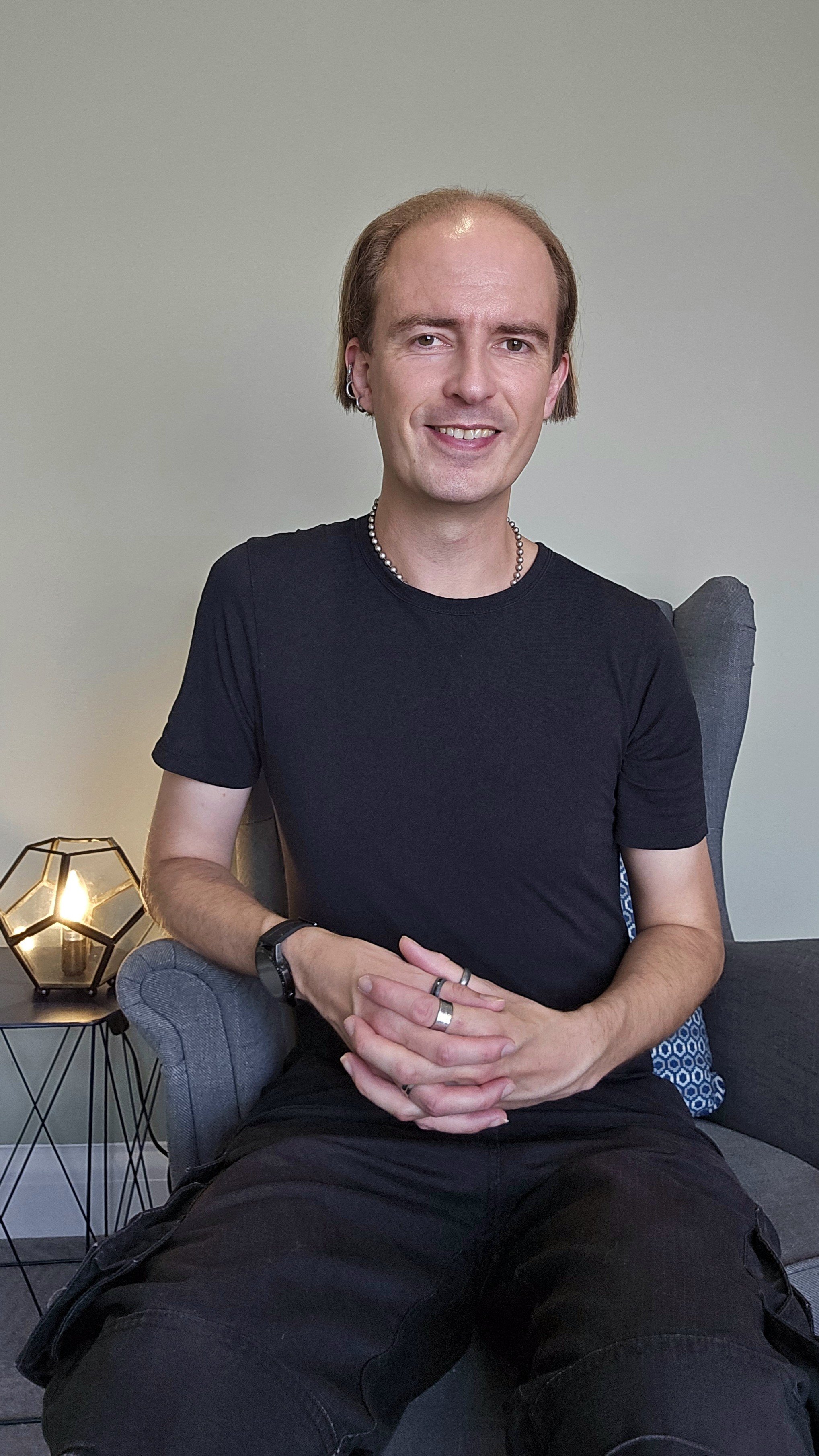
About Me
-
I’m a Level 7 Qualified Counsellor living in West Bridgford and I grew up in the south of England. In my previous career I was an engineer and team leader working for global organisations, followed by working for the NHS on the frontline of Covid 19 mass vaccination, and then as a Deputy Service Manager in Nottingham Hospitals. In my career history I’m familiar with high stress, pressured environments, complex organisations, tight timescales and power imbalances.
In counselling & psychotherapy I’m calm, friendly, easy to talk to, organised, reliable, transparent, and everyone is welcome - I’m inclusive and encouraging of all forms of diversity and uniqueness.
I bring my analytical qualities to my counselling & psychotherapy work which is a key part of the theoretical depth and clinical competency that I have. I also bring my real self, and all of the qualities of myself that are of service to supporting my clients, as part of a humanistic, integrative and relational approach.
Here I am introducing myself on YouTube
-
Counselling & therapy supports people in finding better quality of life, and feeling better, in present-day and in the future. Each individual person is empowered to choose what it means to ‘feel better’.
There is a combination of factors involved in achieving the client aims, but it likely involves talking about attachment styles, self-esteem and shame, identity, boundaries with others, and building up emotional resilience.
See me talking about the purpose of counselling & therapy on YouTube
-
My Level 7 training means I have advanced understanding of complex feelings and relationship dynamics. This means that in addition to looking at surface-level symptoms, such as anxiety, we will also gently uncover the original root causes that lie in the underlying attachment styles, defences, and past experiences that keep you feeling stuck. This then helps us find lasting solutions by attending to the underlying causes, not just the symptoms.
I'm easy to work with because I bring answers and clarity on complex topics that feel deeply confusing. I have a steady, reassuring presence with the integrity and consistency that means I'm easy to trust. I'm organised, will have a plan, and I work with careful pacing to ensure people feel safe while also helping them feel better as soon as possible
See me talking about attending to underlying root causes on YouTube
-
Getting started can be daunting so here’s how it typically goes so you know what to expect:
The Free 20 Minute Introductory Call: A no-pressure video call or telephone call where you can tell me a bit about what brings you to therapy, and we can see if we feel like a good fit.
The First Session: We will agree to meet in-person at one of the therapy centres that suits you best, or we can meet online. Typically the first session is about establishing safety and our initial relationship, while also seeing what ‘quick wins’ might help you feel better immediately.
Sessions 2-10: You are in control of the pace and what you would like from each session. I will be ensuring that the depth of our work in this early stage is managed for safety and matches the growing trust of our relationship.
Practical Details: Sessions are an hour and are usually on a consistent day & time. Our work is ‘talking therapy’ so it is purely a conversation; there is no expectation to do more than talk or ‘perform’ in any way.
See me talking about building trust in the therapeutic relationship on YouTube
-
There are benefits and weaknesses of both approaches:
Online (video, virtual, remote, digital, teletherapy) is low-cost, flexible at short notice, efficient, productive, consistent and predictable. It feels safer and less stressful for some clients who find it harder leaving the house. It's disability and mobility friendly, and puts clients in touch with therapists at long-distance. However, it doesn't give as much of a 'rich' fulfilling experience compared to in-person; it relies on having a confidential space and strong internet signal; and it isn't well-suited for very relational work compared to in-person.
In-Person work brings a much richer overall therapeutic experience, in terms of leaving the house to visit a real therapy space that feels physically safe, and in the company of a real human therapist. However the experience comes with some overheads in added cost for room rental (or a bigger house, for therapists who work from their home); it's much less flexible to reschedule; and it's less efficient, as more can be done online in 60 minutes than in-person, plus travel time, parking, etc. There are also more 'variables' from door-to-door in attending in-person that make it slightly less of a predictable, consistent, safe, experience.
Overall I'm committed to offering both and I value the benefits of both, and it's empowering for the client to have the choice.
See me talking about it on YouTube
-
Underneath present-day emotional struggles and complex relationship patterns are typically two elements:
Identity and self-view
Attachments with others
These are formed in our earliest years of life. See me talking about this on YouTube
Any interruptions in our formation of self and our attachments with others - for example through childhood abuse & neglect or any kind of developmental trauma - will leave underlying imprints that tend to emerge in present-day adult lives. This could include identity confusion, a negative view of ourselves, and unstable relationships.
I work with clients to bring clarity to their sense-of-self; build self-esteem; and work on the thinking, feeling and behaviours needed to soothe anxiety, lift depression and establish secure relating.
My top specialities are:
Unclear and negative view of self (identity confusion, low self-esteem, shame).
Attachment Styles
Early-years childhood abuse, neglect and developmental trauma.
My full list of specialities:
Addiction
Adverse Child Experiences
Anger
Anxiety
Attachment trauma
Borderline Personality (BPD/EUPD)
Childhood trauma
Complex PTSD
Depression
Developmental trauma
Dissociation, defences
Domestic abuse
Grief, sadness, loneliness
Narcissistic Personality (NPD)
Narcissistic Abuse
Obsession, Limerence
Obsessive-Compulsive (OCD)
Relational trauma / Interpersonal trauma
Schizoid Personality
Self Esteem, Confidence, Guilt and Shame
Self-Harming
Sexual Abuse or Violence
Stress, Overwhelm
Suicidal Ideation, Despair
-
I have a Level 7 Diploma in Transactional Analysis Counselling awarded by The Berne Institute. This required three years (360 hours) part-time in-person training and 200 client work experience hours. Since 2024 I've volunteered in the role of Counsellor for the charity Clean Slate who support abuse survivors. Prior to this, I was awarded a Level 7 Foundation Certificate in Transactional Analysis theory, which was one year (120 hours) part-time.
-
In total I’ve trained for six years part-time and completed >600 in-person core training hours in Transactional Analysis Psychotherapy at The Berne Institute on a UKCP-accredited training programme. The clinical training included relational dynamics, complex trauma, personality disorders, attachment patterns and much more. I've finished training and I’m in the final year of accruing the remaining client hours under clinical supervision towards a Postgraduate Diploma and UKCP Registration in Humanistic & Integrative Psychotherapy. This is top-tier training aligned with SCoPEd Column C. The HIPC training requirements are here.
-
I’m a UKATA Diploma qualified member and listed in their public directory here. I’m temporarily a Student Member of the National Counselling & Psychotherapy Society (NCPS) and I’ve applied for full MNCPS Accredited Registrant membership via the CACE process. I operate under the NCPS code of ethics which is here. I’m also a Trainee Psychotherapist Member of the United Kingdom Council for Psychotherapy (UKCP), which means I’m in the final year of working towards the required clinical practice hours under supervision to achieve UKCP clinical registration as a Psychotherapist. I belong to the UKCP Humanistic & Integrative Psychotherapy College, and I’m listed in the UKCP online Trainee Directory. The UKCP code of ethics & professional practice is here.
-
I’ve set up a modern professional practice management system, which greatly enhances a Client’s therapeutic experience of a reliable, reassuring, consistent, efficient service from me in alignment with Trauma-Informed Practice. I use WriteUpp practice management software for GDPR and ISO27001-certified client details, contracts, bookings, text & email communications, session notes, smart forms, invoices and card payments. I have a certificate from the Information Commissioner's Office (ICO) to store and protect personal data; I have professional indemnity insurance; and I have an Enhanced DBS certificate.